
For many late-identified Autistic and AuDHD adults, life can feel like a performance. You might excel at work, navigate social gatherings, and maintain relationships. Yet you collapse from exhaustion the moment you are alone.
This deep gap between your external presentation and internal reality often results from a lifetime of Autistic masking. Masking is a draining, often subconscious survival strategy. Over time, it can lead to serious burnout.
More Than “Acting Normal”
Masking is not just “acting normal.” Emerging research on Monotropism (a theory that Autistic brains focus deeply on single interests or tasks) suggests that masking forces the brain into constant split attention. You monitor your face, your tone, and the other person’s reaction all at once. This level of cognitive load is not sustainable.
Understanding this mechanism is the first step toward reclaiming your energy, identity, and well-being.
What is Autistic Masking?
Autistic masking, also known as camouflaging, is the conscious or subconscious suppression of natural Autistic traits. It involves performing neurotypical behaviors in social settings. It is not about being deceptive. Rather, it is a protective strategy developed to avoid judgment, bullying, or social exclusion.
For many, masking begins in early childhood as a response to conditioning:
- Being told to “stop fidgeting”
- Being forced to “make eye contact”
- Being shamed for having intense, specific interests
This early conditioning teaches an Autistic child that their natural way of being is “incorrect.” To survive socially, they build a “false self” based on what they observe from peers, media, and societal norms.
The Cost of the False Self
The mask becomes a shield. However, it also disconnects you from your authentic thoughts, feelings, and needs. Over decades, this can lead to a deep sense of identity loss. You may no longer know who you are without the mask.
The 3 Types: Camouflaging, Fawning, and Compensation
Understanding the nuance of your own masking is the first step toward safety. Masking generally falls into three categories:
- Camouflaging: Hiding Autistic traits. This includes suppressing stims (like hand flapping or rocking), forcing eye contact even when it hurts, or hiding intense interests to avoid being seen as “weird.”
- Compensation: Developing scripts and strategies to bypass difficulties. If you struggle with small talk, you might memorize safe phrases about the weather or local sports teams. While helpful, relying entirely on scripts prevents genuine connection.
- Fawning: The most exhausting and dangerous form. Fawning is a trauma response where you suppress your own needs, opinions, and boundaries to appease others. Unlike camouflaging, which hides traits, fawning erases the self.
If you constantly agree with opinions you do not hold or apologize for taking up space, you may be stuck in a fawn response. This pattern is especially common in late-identified women and gender-diverse individuals. You can read more about how these traits show up in our guide on signs of autism in women.
The Cost of Fitting In: Healthy Adaptation vs. Toxic Masking
The effort needed to maintain a mask is immense and unsustainable. Everyone adapts socially to some degree. The key is telling apart healthy adaptation from toxic masking that leads to burnout.
| Feature | Healthy Adaptation | Toxic Masking (Burnout Risk) |
|---|---|---|
| Energy Cost | Low to Moderate; recoverable with rest. | High; requires days of recovery (shutdown). |
| Sense of Self | You feel like “you” but polite. | You feel like an actor or a fraud. |
| Motivation | Desire to connect or be kind. | Fear of rejection, safety, or punishment. |
| Aftermath | Satisfaction from social interaction. | Exhaustion, shame, or “social hangover.” |
| Consistency | Flexible; changes based on context. | Rigid; the mask stays on even when alone. |
What Toxic Masking Looks Like
Toxic masking involves several simultaneous cognitive tasks:
- Continuously checking your posture, facial expressions, and tone of voice
- Deciphering non-verbal cues and predicting social outcomes
- Actively suppressing natural impulses like stimming
- Mentally rehearsing conversations before they happen
In the Pacific Northwest, the “Seattle Freeze” adds another layer of pressure. Ambiguous social cues and a reserved culture make it even harder to know if you are performing “correctly.” As a result, the need to mask grows even stronger.
The Link Between Masking and Autistic Burnout
When your brain’s processing power is perpetually diverted to masking, little energy remains for anything else.
Research suggests that neurotypical people can often still detect a difference within seconds, despite the immense energy Autistic people put into masking. They may not identify it as autism. Instead, they might see the masked person as “aloof,” “arrogant,” or “untrustworthy.”
The tragedy of masking is that it often fails to achieve the social acceptance it aims for. You burn out trying to hide, only to face rejection anyway. Recognizing this paradox is painful. However, it is also freeing. It gives you permission to stop trying so hard.
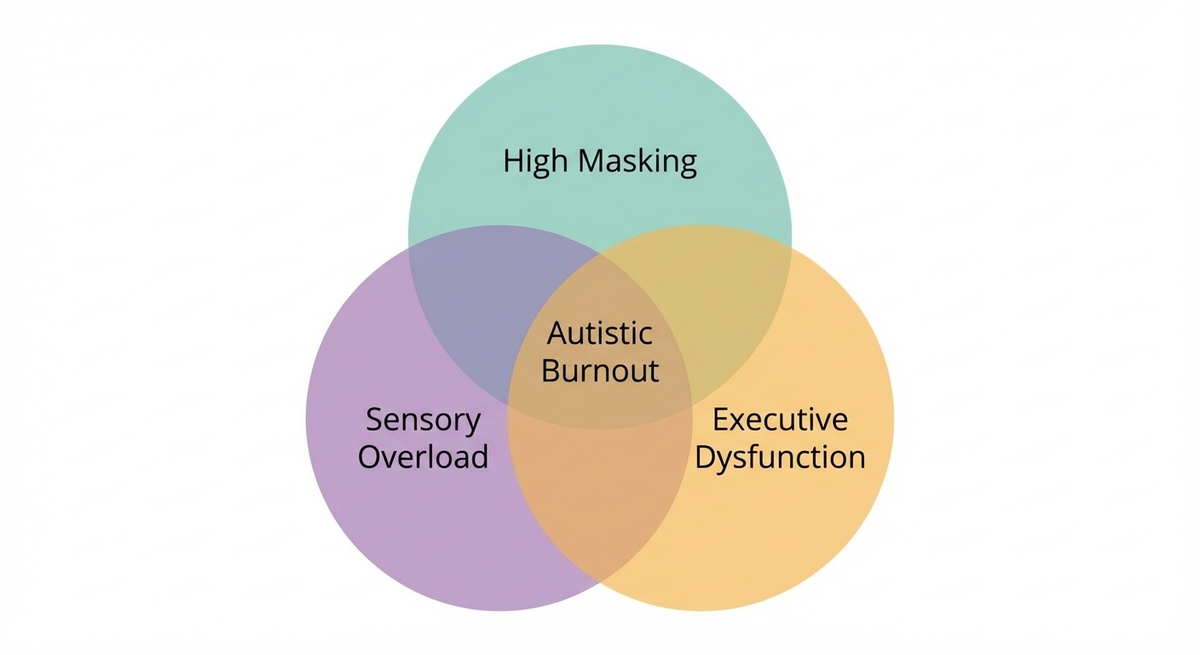
This chronic energy deficit leads directly to Autistic Burnout. Autistic Burnout is a state of deep exhaustion that affects thinking, emotional regulation, and physical health. Many people do not realize that autism burnout is real and exhausting until they are deep within it.
8 Signs You Are Masking (Even If You Don’t Know It)
Masking often becomes automatic. You may not even realize you are doing it. Here are common signs, especially for late-diagnosed women and gender-diverse folks.
1. Forced Eye Contact and Physical Pain
You consciously remind yourself to make eye contact during conversations. It feels unnatural, overwhelming, or physically painful. You might look at the bridge of someone’s nose or look away to cope. But the effort is always there.
2. Scripting Conversations and ‘Rehearsing’ Life
You spend significant time planning for social interactions. This can include:
- Rehearsing potential conversation topics
- Planning jokes in advance
- Reviewing past conversations to analyze your “performance”
You rarely feel spontaneous in social settings.
3. The People-Pleasing Trap and Conflict Avoidance
You consistently agree with others or suppress your own needs to avoid confrontation. The thought of conflict feels so overwhelming that you would rather accept discomfort than risk social friction. This often stems from a deep fear of rejection.
4. Mirroring Others’ Personalities
You adopt the mannerisms, accents, or interests of the people around you to blend in. For a masking Autistic person, this can be so extreme that you feel like a chameleon. You may feel you have no stable personality of your own.
5. Suppressing Your Stims
You consciously stop yourself from self-regulating behaviors like:
- Rocking or pacing
- Tapping your fingers
- Flapping your hands
You were taught these are socially unacceptable. You might redirect this energy into smaller, less noticeable actions like clenching your toes or jiggling your leg under a table.
6. Hiding Your Special Interests
You avoid talking about your deep, passionate interests for fear of being seen as weird, obsessive, or boring. You might feign interest in neurotypical topics like small talk or celebrity gossip to appear more relatable.
7. Forcing or Faking Facial Expressions
You consciously perform facial expressions you believe are expected. This might mean smiling at a joke you do not find funny or showing sympathy on cue. Your natural expression might be neutral. However, you have learned that this makes others uncomfortable.
8. Post-Social Collapse
You hold it together perfectly at work or in social settings. But the moment you get into your car or home, you lose the ability to speak or function. This is not just introversion. It is a complete drain of your social, cognitive, and physical energy.
Strategic Unmasking: A Safety-First Framework
Unmasking is not about dropping your shield overnight. In fact, total unmasking can be risky in non-affirming spaces. Instead, we advocate for Strategic Unmasking: a safety-first approach to reclaiming your energy using a Safety Audit.
Think of it as replacing a rigid, suffocating wall with a “permeable mesh.” You get to decide what comes in and what goes out. This lets you be your authentic self in safe settings while still using social tools when needed.

Step 1: The Safety Audit (Assessing Your Environment)
Do not drop the mask everywhere at once. Instead, grade your environments on a scale of 1 to 5:
- Level 1 (Unsafe): Hostile work environments, unsupportive family members, or public spaces where safety is a concern. Strategy: Keep the mask on. Protect your energy. Do not make yourself vulnerable here.
- Level 3 (Neutral): Grocery stores, casual acquaintances, or neutral workplaces. Strategy: Soften the mask. You might stop forcing eye contact but keep social scripts.
- Level 5 (Safe): Alone, with a partner, or with neurodivergent friends. Strategy: Full unmasking. Allow stimming, silence, and authentic communication.
Your goal is to increase the time spent in Level 5 environments and minimize the energy spent in Level 1 environments.
Step 2: Reclaim Your Stims (Sensory Regulation)
Stimming is how Autistic nervous systems regulate. Masking often involves suppressing these movements. Therefore, reclaiming them is essential for healing burnout.
Start small in your Level 5 (Safe) spaces. If you need to rock, rock. If you need to hum, hum. In the Pacific Northwest, where gray skies can affect mood, sensory regulation is even more important.
You might create a “sensory nest” in your home with:
- Weighted blankets
- Low lighting
- Noise-canceling headphones
For specific regional tips, read our sensory survival guide for the PNW.
Step 3: Reconnect with Your Needs
Masking disconnects you from your sensory and emotional needs. Practice checking in with yourself:
- Are you overwhelmed?
- Do you need a break?
- Do you need to stim?
Give yourself permission to meet those needs. Try a “Dopamine Menu”—list sensory experiences that bring you tiny sparks of joy (a hot drink, a texture, a song). Your identity lives in what regulates you, not what pleases others.
Step 4: Handle the ‘You’ve Changed’ Backlash
As you begin to unmask, people close to you might say, “You’ve changed,” or “You’re acting more Autistic now than before you were diagnosed.”
What they are seeing is not “more autism,” but less masking. You are no longer suppressing your needs to make them comfortable. You can respond with a script: “I’m not changing who I am; I’m just stopping the performance that was making me sick. I hope you can support me in being healthier.”
Dealing with the ‘Regression’ Grief
Many adults, after receiving a diagnosis, experience what feels like a “regression.” They may feel they are losing social skills or becoming “more Autistic.”
In reality, this is often the start of unmasking and the true face of Autistic Burnout. Your mind and body are finally signaling that they can no longer keep up the performance.
Processing the Grief
This period can involve intense grief:
- Grief for the years spent disconnected from your true self
- Anger at the world that made you feel you had to hide
- Sadness for the person you could have been without the mask
This is a valid and necessary part of the healing process. Understanding the often-overlooked signs of autism in women and late-diagnosed adults can be a validating part of this journey.
FAQ: Is it too late to stop masking?
Absolutely not. It is never too late to begin unmasking. This is a slow, non-linear process that takes self-compassion, patience, and support. Every small step toward unmasking saves your energy, reduces burnout, and builds a life that aligns with your true self.
Can I unmask at work? Proceed with caution. Use the Safety Audit. If your workplace is a Level 3, you might ask for accommodations (like noise-canceling headphones or written instructions) without fully unmasking your social personality. Workplace safety varies. If the environment is toxic, prioritize your financial security and mental health over “authenticity.”
If you are in Oregon or Washington and feel that masking has taken a toll on your mental health and identity, you are not alone. Understanding your neurotype is a powerful step toward healing. Haven Health Autism Assessments provides validating, neurodiversity-affirming evaluations for adults. We invite you to learn more about what is involved in an adult autism assessment and take the first step toward understanding your authentic self.
This content is for educational purposes only and is not a substitute for professional medical advice, diagnosis, or treatment. If you have concerns about autism, ADHD, or any other health condition, please consult a qualified healthcare provider.


